
When AI Talks to AI: The Exponential Token explosion of Multi-Agent Systems
The narrative around using AI has shifted rapidly. Over the past year, corporate discussion in the UAE and broader Middle East has centered on basic implementation: connecting an LLM via public cloud APIs to allow employees to summarize documents, answer customer queries, or act as an internal knowledge base.
But forward-thinking companies are looking past the linear prompt-and-response setups. Companies are now entering an era of Multi-Agent Systems. Where a web of specialized AI agents designed to collaborate, debate, and execute complex workflows on their own with very little or no human input.
Whilst this agentic mode means companies can massively improve their operational efficiency, it also introduces it hidden challenges when built on public cloud infrastructure. When AI starts talking to AI, the traditional cloud consumption of AI tokens is completely changed.
The Anatomy of an Autonomous Agentic Loop
To understand why multi-agent systems are financially not viable in the cloud, we need to understand how the work operationally.
Unlike a standard chatbot that takes an input and generates a single output. An autonomous agent uses recursive internal thought loops. When you give an agentic system a high-level document such as a legal contract and ask it to compare it against “UAE Decree-Law No. 45” and then to write a compliance reconciliation report. Multiple APIs are called upon. The Image below explains the complex flow:
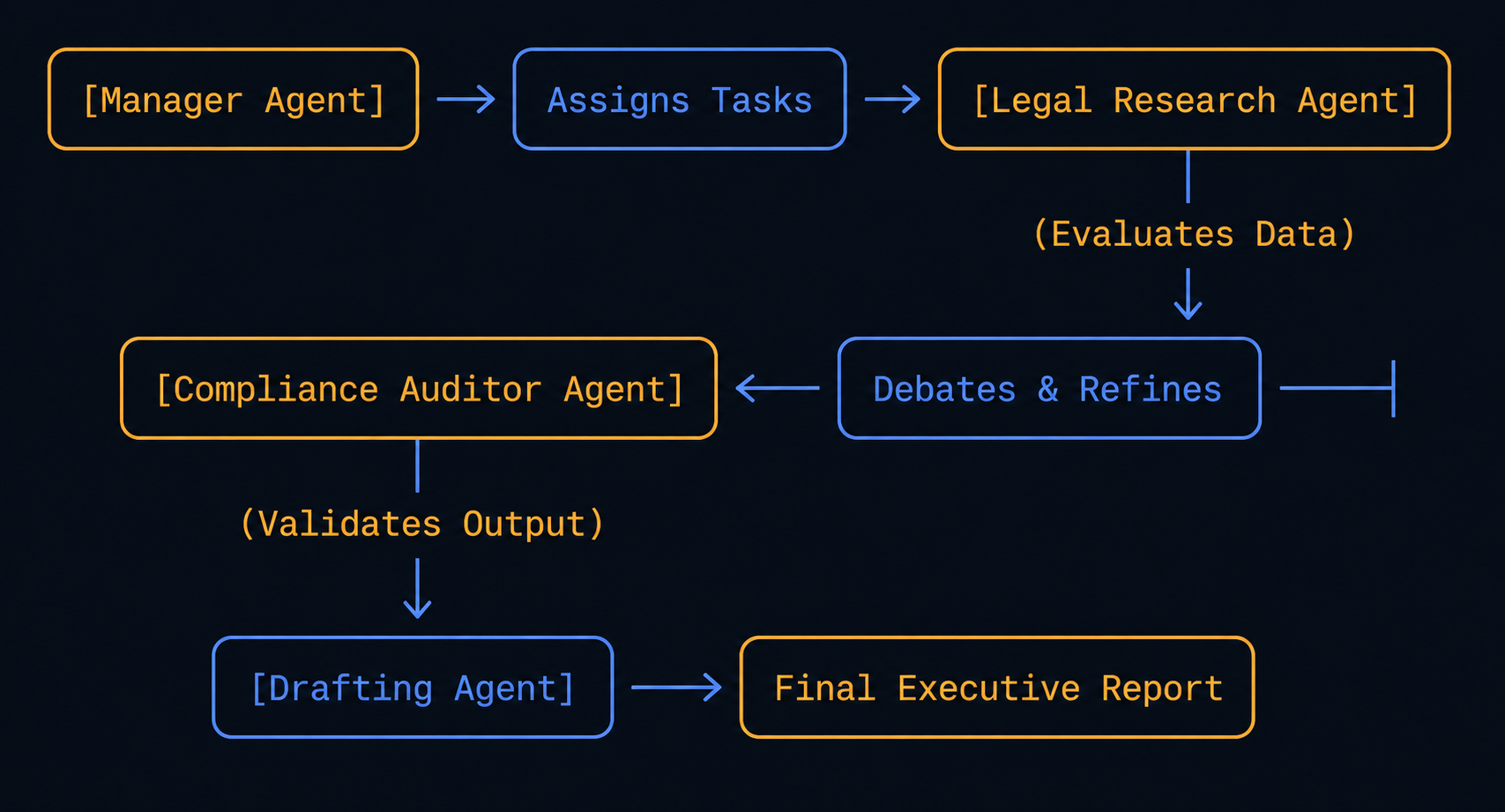
- The Planner/Manager Agent breaks the objective down into several sub-tasks.
- The Research Agent queries the database, pulling chunks of text and analyzing them.
- The Auditor Agent reviews the Research Agent’s output, identifies discrepancies, and sends it back with corrections.
- The Drafting Agent compiles the validated findings into a structured report.
All the internal dialogue, the cross-verification, and corrections the AI agents makes without you seeing. Its the agents internal dialogue to achieve what it thinks is perfection.
Enter Token explosion: How Token Consumption Explodes Exponentially
In a public cloud setup, you are billed via a utility model. A set rate per 1,000 input and output tokens. In a standard linear interaction, making your token cost is highly predictable.
With multi-agent systems, however, token consumption does not scale linearly; it scales exponentially.
1. The Context Window Snowball
Imagine, every time Agent A talks to Agent B, the entire previous conversation history (the context window) must be re-sent through the cloud API. If the agent then requires 15 iterations to solve a complex problem, the input token volume grows exponentially with every single loop. You are now effectively paying to send data back and forth to a remote server until the agent finally makes a decision.
2. The Hallucination/Correction Loop
Agents are designed to self-correct. Therefore if an Auditor Agent catches an error made by the Writer Agent, it triggers a rewrite loop. If the criteria is strict, it can cause the agents to pass messages back and forth 10’s of times before presenting the final answer to the user. In the cloud, you pay for every single mistake, revision, and internal thought process.
3. The Infinite Logic Loop Risk
If a developer wrongly configures a termination condition in a multi-agent workflow, the system can get caught up in an infinite reasoning loop. Meaning, if your developer then goes offline for the weekend. The Agent could spend the entire weekend debating a minor formatting point on an internal server without anyone knowing. If you are using a private AI orchestration (on-prem) setup, this costs nothing but a tiny spike in electricity. Compared to the cloud setup, where you could find out on Monday morning via a multi-thousand-dollar surprise on your API invoice.
The Reality Check: A single complex task executed by a multi-agent team can easily consume hundreds of thousands of cloud tokens in a matter of minutes. Multiply that by dozens of employees running concurrent workflows, and the cloud OpEx model shifts from a manageable utility bill into an impossible financial forecast to make.
Breaking the unpredictable Loop with Local Compute
This financial unpredictability is the reason why many enterprises and smaller companies are pivoting away from public cloud and looking to scale agentic workflows via private AI orchestration. By pulling compute inbound and running open-source models within a privately orchestrated environment, the economic model changes entirely:
Why?
- Zero-Cost Iteration: Because you own the hardware, the cost of an agent executing 1,000 internal thought loops is exactly the same as executing one: $0.
- Predictable Balance Sheets: Finance teams can accurately forecast AI budgets because the operational cost is flattened to the organization’s basic facility utility bill, completely disconnected from token volume.
- True Autonomy: it enables developers more freedom to build a more highly intricate, recursive multi-agent frameworks that can run 24/7 without the worry of an excessively large cloud bill at the end of the month.
Multi-agent systems represent the absolute future of corporate automation. However they require an infrastructure that rewards volume rather than being penalized. If your business strategy relies on a large amount of AI-generated content and your renting public cloud, this is money down the drain It’s time to build something sustainable.
In Part 2 of this series, we will explore The Sandbox Freedom, analyzing how a private orchestration infrastructure allows development teams to build, stress-test, and create iterative automation scripts without the anxiety of a massive bill at the end of the month.