
Staying Within the Law 2026
In March 2026, the UAE transitioned from “Ethical AI Guidelines” to a mandatory Regulatory AI Ecosystem. It is now a legal requirement for every business in the Emirates that uses AI to follow the legal requirements outlined in the UAE AI Act and relevant federal data laws.
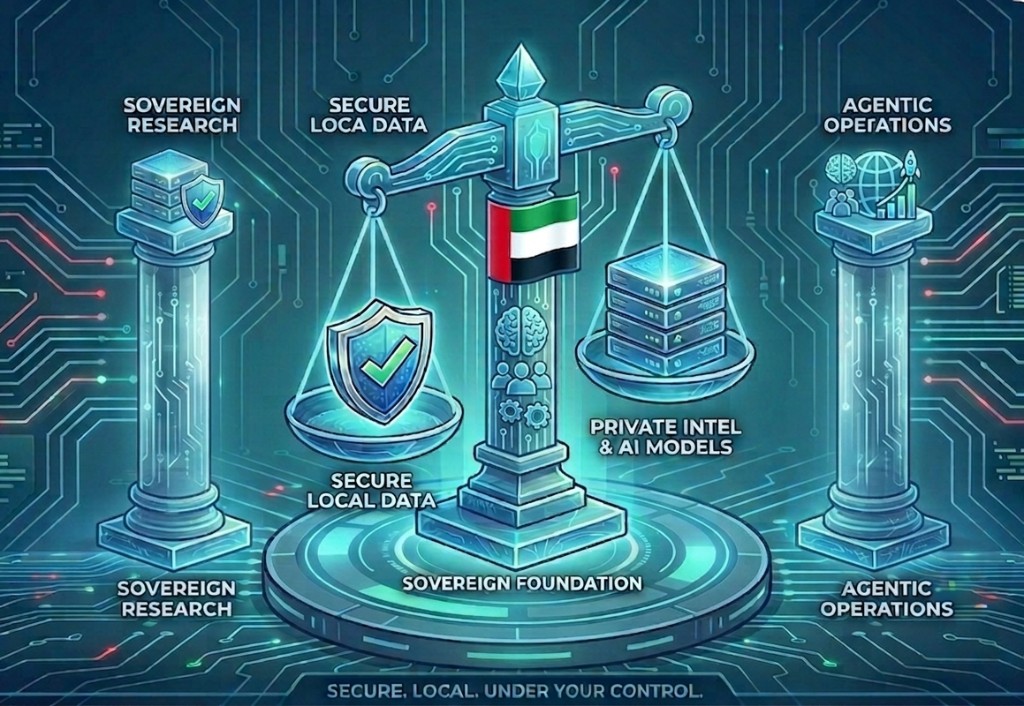
Vizion-AI can provide businesses with on-prem infrastructure that helps ensure they meet the required regulations. By keeping your data and AI models within your company’s local environment, we can help protect your firm from AED 10M+ penalties associated with the misuse of public AI and data residency breaches.
1. The UAE AI Act (Effective March 2026)
The UAE AI Act is the primary legislation governing all AI systems. It uses a four-tier risk model to determine how much oversight your business requires.
The Mandatory Compliance Timeline
- The 6-Month Grace Period: All UAE entities must complete a mandatory AI self-assessment and register their systems in the National AI Registry no later than September 30, 2026.
-
Tier 3 (High-Risk) Mandates: If your AI is used in security, HR, healthcare, or education, you must:
- Conduct an Annual Third-Party Algorithm Audit by an accredited firm.
- Appoint a designated AI Ethics & Compliance Officer.
- Maintain a Technical File for “Explainability” (proving how the AI makes decisions).
- Prohibited AI: Systems involving social scoring, subliminal psychological manipulation, or unauthorized biometric surveillance in public spaces are strictly banned.
- Key Resource: Digital Dubai - AI Act 2026 Compliance Portal
UAE AI Risk Classification & Compliance Table
| Tier | Risk Level | What it Covers (Examples) | Key Industries Impacted | Audit Frequency | Potential Penalties (AED) |
|---|---|---|---|---|---|
| Tier 1 | Minimal | Spam filters, basic internal chatbots, game AI, recommendation engines. | Retail, Marketing, Hospitality, SaaS | Self-Assessment (documented) | AED 50k - 100k |
| Tier 2 | Limited | Customer service bots, automated content generation (GenAI), predictive analytics. | E-commerce, Media, Real Estate, Logistics | Annual Internal Review | Up to AED 500k |
| Tier 3 | High | Credit scoring, hiring/CV screening, medical diagnostics, biometrics. | Fintech, Healthcare, HR, Education | Annual External Audit (by UAE-certified auditor) | Up to AED 2M - 5M |
| Tier 4 | Critical | Autonomous vehicles, smart grid control, real-time public facial recognition. | Cybersecurity, Energy, Transport, Govt | Bi-Annual (Every 6 Mos) + Continuous Monitoring | Up to AED 10M |
Mandatory Requirements for ALL Industries
Regardless of which tier a company falls into, the 2026 Act mandates these steps for every business using AI in the UAE:
Required for EVERY Industry (Tiers 1-4):
- National AI Inventory: Every business must maintain a "Live Register" of all AI tools in use. The register must include each tool's name and purpose. For Tier 1 businesses, this is a simple online form.
- Transparency & Disclosure: If a human is interacting with AI (for example, a chatbot or generated support response), the company must clearly disclose that the interaction is AI-driven.
- The Right to Human Appeal: If AI touches personal data, UAE privacy laws under the Federal Data Protection Law (PDPL) must be followed, including consent and the "right to be forgotten." Customers also have a legal right to request a human review for any high-impact decision made solely by AI (for example, a loan rejection or job application filter).
- Human-in-the-Loop: No system can be fully autonomous without human oversight. The responsible person does not need to be a formal role, but every AI system must have a clear point of contact who can override the system when needed.
Required ONLY for High-Risk (Tiers 3 & 4):
- Designated AI Ethics & Compliance Officer: A formal role with a direct reporting line to the board.
- Third-Party Audits: Tiers 3 and 4 must hire a government-accredited auditor.
- Technical Documentation: You must keep technical documentation proving how the AI makes decisions.
- Pre-Deployment Approval: Tier 4 must receive approval from the UAE AI Authority before the system is switched on.
UAE Charter for the Development and Use of AI (June 2024)
Originally launched in 2024, the Charter is now legally cross-referenced in the National AI Registry application.
-
Why It Matters: This Charter is the primary benchmark used during annual federal “Algorithm Audits” for high-risk AI systems.
- Human-in-the-Loop (HITL): High-stakes AI cannot operate with total autonomy. There must be a documented “Human Override” protocol for every system.
- Data Sovereignty: AI models must respect UAE citizen data residency. This favors locally hosted public clouds over international ones.
-
Key Resources:
- Official Charter PDF: The full list of 12 principles.
- AI Ethics Principles & Guidelines: Practical steps for making AI fair and accountable.
- Generative AI Guide: 100+ use cases and best practices for Gen-AI deployment.
You can usually find these via the UAE’s official AI resources pages.
*Please note: links to government documents can change at short notice.*
UAE National Strategy for Artificial Intelligence 2031
This roadmap outlines the strategy which drives AI-related legislation, procurement, and investment decisions across the UAE. It dictates federal investment, public-sector procurement rules, and the legislative roadmap.
- Why It Matters: Businesses aligned with the eight strategic objectives are prioritized for government partnerships and new AI R&D tax credits launched in 2026.
-
Key Resources:
- National AI Strategy 2031 (Full Roadmap): The executive vision for a 100% AI-enabled government.
- AI Strategy Overview: A summary of the key sectors (Education, Healthcare, etc.) targeted for transformation.
Other critical legal frameworks
The AI Act does not work in isolation. In order to be fully compliant, your AI deployment must satisfy these existing federal statutes:
- Data Privacy (Federal Decree-Law No. 45 of 2021): The “GDPR of the UAE.” Any AI processing personal data must have a Data Protection Impact Assessment (DPIA). Federal Decree-Law No. 45 of 2021 and UAE data protection laws.
- Cybercrimes (Federal Decree-Law No. 34 of 2021): Strictly governs the creation of AI-generated content, deepfakes, and the unauthorized use of automated bots. View law.
- Child Digital Safety (Federal Decree-Law No. 26 of 2025): Critical for any AI tools used in educational or creative sectors involving minors. View law.
- Abu Dhabi Oversight: Abu Dhabi-based firms are also governed by the AI and Advanced Technology Council (AIATC) under Law No. 3 of 2024. Abu Dhabi Media Office.
| Industry | Key Regulation / Act | Impact on AI Use |
|---|---|---|
| Education | Safe Use of AI in Classrooms (2026) | Strictly prohibits student data from being stored in public clouds; AI used for student grading must include human-in-the-loop oversight. |
| Real Estate | Federal Decree-Law No. 45 (PDPL) | AI-driven lead scoring must comply with strict UAE data residency rules; data must remain on UAE-hosted servers. |
| Creative Agencies | Federal Decree-Law No. 34 (Cybercrimes) | Prohibits the use of AI for unauthorized deepfakes or non-consensual brand manipulation. Full disclosure/watermarking of AI-generated media. |
| Hospitality | Consumer Protection Law No. 15 | AI assistants must provide "Transparency Notices" and protect guest booking data. |
| Construction | Building Safety AI Standards (2026) | Using AI for predictive maintenance for critical infrastructure is classified as Tier 3 (High Risk). |
| Healthcare | ICT in Health (Federal Law No. 2) | AI diagnostic tools must maintain 100% data localization within UAE borders. |
| Government | UAE National Strategy for AI 2031 | Targets 50% AI adoption with mandatory annual "Maturity Self-Assessments." |
Your Compliance Checklist
To avoid the risk of suspension or heavy fines, ensure your business takes the following steps before September 2026:
- Classify: Determine if your AI is Tier 1, 2, 3, or 4.
- Appoint: Designate an AI Ethics Officer (for Tiers 3 & 4).
- Register: Submit your system details to the National AI Registry.
- Audit: If High-Risk, book your audit with an Accredited Algorithm Auditor.
- Localize: Migrate sensitive AI workloads to on-premise or UAE-sovereign servers.
Ready to own your intelligence? Stop uploading your company’s future to the public cloud. Join the ranks of the UAE’s most secure firms by bringing your AI home.