
For the past two decades, software budgeting was a predictable exercise. Enterprise leaders purchased a fixed number of licences for their employees, negotiated annual platform costs, and projected their operational technology expenses—understanding clearly their budget for the year. If an employee used the software five hundred times a day or five times a month, the cost remained unchanged.
Generative AI has fundamentally shattered that model. By shifting the entire industry from fixed-cost to variable consumption models with “per-token” billing, businesses have now unknowingly stepped into a volatile operational landscape. In the enterprise AI rush, many organizations are encountering a silent budget killer: the unmanaged token tax.
The anatomy of a token bill
To understand why businesses’ AI budgets are breaking, the technical marketing jargon needs to be overlooked. A token is roughly three-quarters of a standard word. However, in corporate billing, not all tokens are created equal. Organizations that deploy large language models (LLMs) via cloud APIs assume there is a uniform cost framework. It is only later that they discover the staggering asymmetry between input and output costs.
In modern cloud architectures, generating text requires significantly more computational power than reading it. Consequently, output tokens routinely cost three to eight times more than input tokens. If an AI system creates a comprehensive compliance report, generates structured database records, or drafts the company’s social media marketing post, the financial meter accelerates drastically in the output generation phase.
The geometric multiplier of multi-agent systems
The financial risk scales exponentially when moving from manual to advanced autonomous systems and multi-agent workflows. Modern enterprises need to use multiple specialized AI agents which then collaborate to execute end-to-end tasks. While this is operationally impressive and helpful to the employee, it introduces a severe financial multiplier.
As an example:
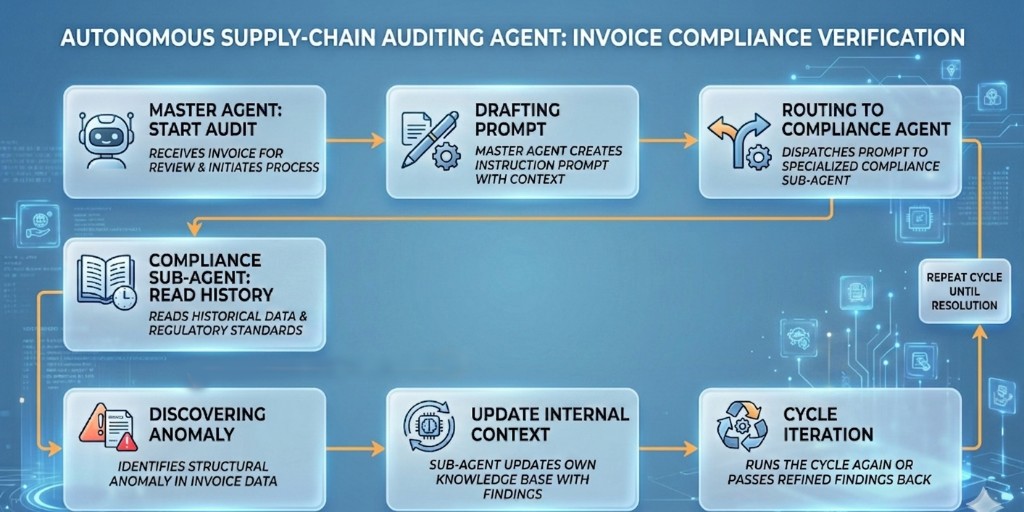
Because LLMs have no organic memory, they must re-read their entire conversational history alongside every new piece of information to maintain coherence. This means that if an agent struggles to resolve a complex data formatting issue, it can process millions of input tokens repeatedly within seconds without the employee even knowing. The business is then billed continuously for every single iterative attempt, causing an intended micro-transaction to become a multi-thousand-dollar overnight overrun.
The long-term corporate risk
When enterprise AI usage moves from isolated and experimental workflows to handling hundreds of thousands of daily workflows, token tracking becomes unmanageable. Without rigorous architectural governance, usage monitoring, and a way to predict costs, companies risk installing infrastructure connected directly to the public cloud—ready for cloud providers to gobble up capital without leadership knowing.
To scale AI sustainably, executive leadership must move from raw model adoption to sophisticated compute economics. The era of treating AI as a traditional fixed-cost software utility is over. AI must now be budgeted for, managed, and audited.
For governance context, see C Level Accountability: UAE Leaders & AI Output. To explore private hosting and cost control, visit Sovereign AI.