
The Sovereign Infrastructure Solution (The Fix)
One of the Key flaws of the modern AI in businesses is a dependence on metered, 3rd party intelligence. Imagine when every thought process taken by an agent incurs a small API charge. Soon, that scales to become a an exponential financial liability.
The solution to this bottleneck is Sovereign Infrastructure. This involves migrating agentic workflows to local, high-performance, on-prem hardware. By transitioning from a variable cost model (API tokens) to a fixed capital expense. Organizations no longer have the infrastructure costs they used to have. Instead, they have an agentic model that has zero penalties and fixed costs.
1. The Economics of Independent architecture
In a cloud-centric architecture, every autonomous loop, validation check or self-correction is an API cost. Rather than having the freedom to use agents for creativity, without the worrying unknown costs. Instead it causes a psychological barrier. The worry of costing the company money without knowing it
By owning the compute stack, you radically alter the economic equation:
- Fixed Capex vs. Runaway Opex: Once high-performance hardware (such as GPUs or workstation clusters) is acquired, the cost of running agents drops significantly. Whereby the additional cost is just the power to run the machines.
- The Zero Financial Penalty Era: An agent on private hardware can run a multiple chain of thought processes to resolve a single complex code execution. Costing the same as if it had run one single thought process.
- True Innovation Through Infinite Failure: AI agents learn, refine, and optimize through iterative loops. If an agent can test or run complex data analysis 24/7 without the additional cost that the cloud brings, it makes the private Infrastructure truly innovative.
2. Architecture of an On-Prem Agentic Factory
Shifting to Sovereign Infrastructure does not mean sacrificing state-of-the-art performance. Open-source ecosystems have now reached a point where they challenge or exceed the performance of generic API models, when it comes to specialized workflows.
The Compute Layer
The backbone relies on highly dense local compute. Depending on the scale needed. These can range from high-end workstations with multi-GPU, to dedicated server racks, housed in private server rooms or private data centers.
The Model Inference Pipeline
In order to achieve low latency required for massive agentic loops, the software stack must bypass slow, poorly optimized run times.
- Inference Engines: Deploying models with a high-throughput, utilizes advanced memory management strategies. This maximizes concurrency and ensures token generation works at incredibly fast speeds.
- Quantization: Leveraging advanced quantization techniques allows massive, and highly capable open-weight models to fit comfortably within local VRAM. Without any noticeable degradation in reasoning capability.
The Execution Framework
Local orchestrators act as the private control plane for these agents. The frameworks are deployed completely offline, they then route tasks directly to local inference endpoints. Localized queries are then executed all within the isolation of a sandbox environment.
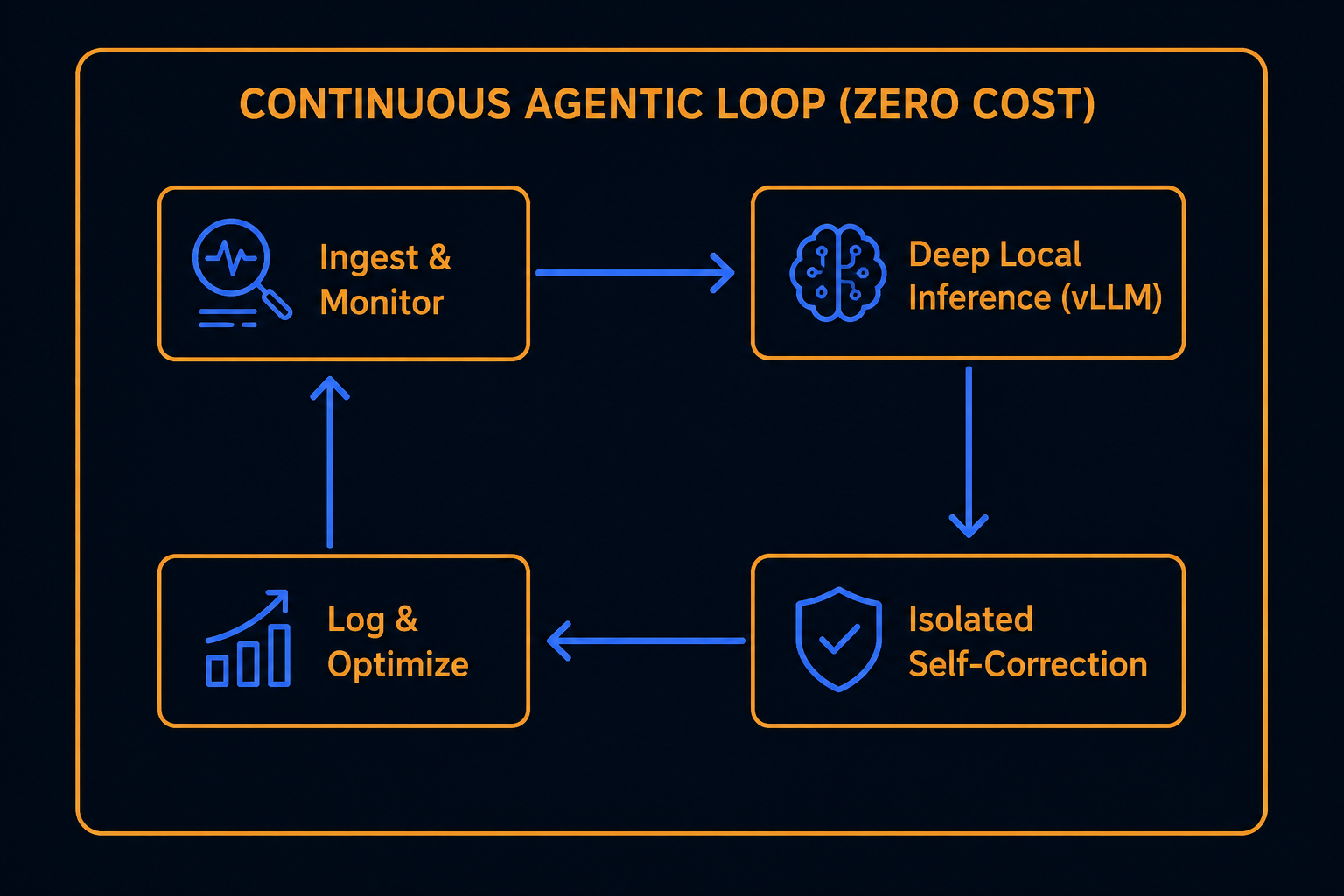
3. Unlocking Continuous, 24/7 Agentic Workflows
When compute is sovereign, agents no longer wait for a human to give the prompt. Instead, they transform into an autonomous, 24/7 digital workforce.
- Autonomous Security: Local cybersecurity agents can continuously scan business source codes, run automated penetration testing loops, and monitor network logs in real-time. Since they are run locally, there is zero risk of exposing internal network topology or proprietary source code to external APIs.
- Background Codebase Evolution: Local agent can run overnight whilst the office is closed. It can systematically hunt for technical liabilities, write unit testing scripts or prepare requested reports ready for human review the next day
- Perpetual Market and Fintech Simulation: Agents can continuously ingest new data, run deep-dive algorithmic simulations or create risk-modeling scenarios. They have the ability to stress-test investment models. All which would be virtually impossible from a financial perspective if you were to use Public APIs. With Local private agents this not something to worry about.
By reclaiming control of your infrastructure through Sovereign Architecture, businesses can break free from the volatile costs off external APIs and the hidden risks that come with using 3rd infrastructure. Compute is no longer a variable cost dictated by external providers, but an internally controlled asset. Running and controlled by the organization its self.
This is where Vizion-AI becomes the catalyst. By enabling sovereign, localized AI deployment, Vizion-AI transforms AI from a rented capability into an owned asset. The result is not just reduced cost and improved security, but a structural shift in power. The dependency on external systems no longer exists and instead becomes a resilient, business controlled AI foundation built for scale, speed, and strategic independence.
To explore private hosting and sovereign deployment, visit Sovereign AI.