
AI Infrastructure: The Foundation of Modern Enterprise
The 2026 Strategic Choice: Cloud AI offers instant speed for experimentation, while On‑Premise AI provides the long-term data sovereignty and cost-control required for core business operations.
As businesses move from AI experimentation to core operational integration, your infrastructure is no longer just “IT”—it is a strategic asset. Whether you are running Large Language Models (LLMs) for data analysis or computer vision for site security, your deployment choice dictates your long-term costs and data control.
Cloud vs. On‑Premise AI Servers: Strategic Comparison
Choosing the right environment depends on your specific workload volume, the sensitivity of your data, and your internal technical capacity.
| Feature | Cloud AI (SaaS/IaaS) | On‑Premise (Private) |
|---|---|---|
| Data Privacy | Shared responsibility; processed on 3rd party hardware. | Full Sovereignty; data never leaves your physical perimeter. |
| Initial Cost | Low (OpEx); pay-as-you-go per token or hour. | High (CapEx); upfront investment in GPUs and cooling. |
| Long-Term Cost | Can spike with high, consistent daily usage. | Lowest TCO; hardware pays for itself over 3–5 years. |
| Scalability | Instant; spin up 100 GPUs in minutes for big projects. | Planned; requires physical setup (weeks). |
| Speed (Latency) | Dependent on internet (80ms–400ms). | Instant; local network speeds (under 20ms). |
| Maintenance | Managed by Amazon, Google, or Microsoft. | Managed by internal IT or a Managed Contract. |
| Compliance | Reliant on vendor certifications (GDPR/HIPAA). | Native Adherence; you own the audit trail. |
What are the trade‑offs?
The case for cloud
The cloud is ideal for variable workloads—such as a monthly financial audit or seasonal data processing.
The case for on‑premise
For enterprises where data is the “crown jewel,” on‑premise is the Gold Standard. In 2026, we are seeing “Inference Inversion”—a trend where it is now 10x cheaper to run your own models locally than to pay a “token tax” to a public API for every single query.
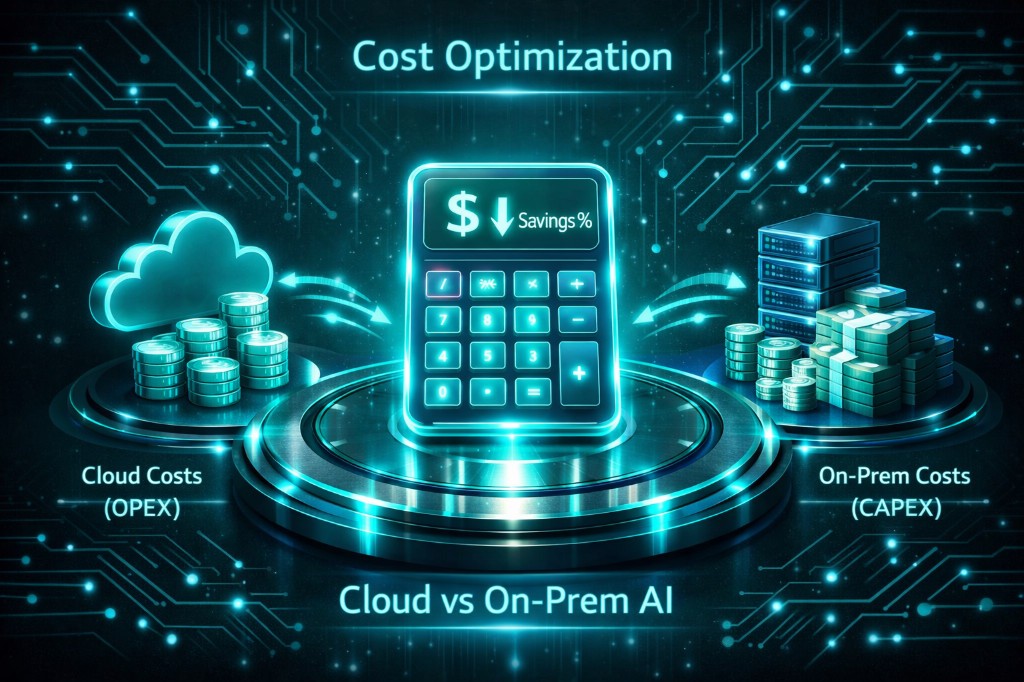
AI Infrastructure: 3‑Year Cost‑Benefit Calculator (2026)
This calculator estimates the Total Cost of Ownership (TCO) across different business scales. In 2026, the “break‑even” point for on‑premise hardware has dropped significantly due to the high “token tax” of cloud APIs and the availability of efficient Small Language Models (SLMs).
1. The scaling roadmap: cloud vs. on‑premise
The following table compares a standard Cloud Managed Service (GPU‑as‑a‑Service + API fees) against a Private AI Server (CapEx + 3 years of OpEx).
| Business Size | Typical AI Use Case | 3‑Year Cloud Est. | 3‑Year On‑Prem Est. | Break‑Even | Details |
|---|---|---|---|---|---|
| 1–10 Employees | Basic Research & Search | $18k – $35k | $12k – $22k | 14–18 months | Learn more |
| 11–30 Employees | Workflow & Coding | $65k – $120k | $35k – $55k | 9–12 months | Learn more |
| 31–50 Employees | Custom Private Models | $180k – $300k | $85k – $120k | 6–8 months | Learn more |
| 50+ Employees | Enterprise‑wide Agents | $500k+ | $250k – $450k | < 6 months | Learn more |
2. Choosing your strategy
Tier 1: Small team (1–10 employees)
- Cloud approach: Utilising “Pro” subscriptions (e.g. ChatGPT Enterprise, Claude Team) at ~$30–$60/user/month.
- On‑premise approach: A high‑end workstation (e.g. RTX 5090 or dual RTX 4090s) running open‑source models (Llama 3, Mistral).
- The verdict: At this scale, the cloud is often easier, but on‑premise wins on privacy. If you handle sensitive client data, the $15k investment in a private box can pay for itself by reducing breach exposure.
Tier 2: Growing agency (11–30 employees)
- The “token trap”: As 20+ people use AI daily for heavy tasks, API costs spike.
- On‑premise approach: A dedicated mid‑tier server rack (e.g. 4x RTX 6000 Ada) located in the office or a local colocation.
- The verdict: This is the “sweet spot” for repatriation. You can often replace $3,000/month in cloud bills with a one‑time $40k hardware spend.
Tier 3: Mid‑market (31–50 employees)
- The power user: At this scale, you are likely fine‑tuning models on proprietary data.
- On‑premise approach: Multi‑node GPU clusters (e.g. NVIDIA H100 or the newer B200 Blackwell units).
- The verdict: On‑premise is often mandatory for cost control. The “Token Economics” of 2026 show owning hardware can be far cheaper per million tokens than high‑tier cloud APIs at this volume.
Tier 4: Enterprise (50+ employees)
- Scaling limit: Cloud providers may impose rate limits or “priority” pricing that penalises high‑volume users.
- On‑premise approach: Private Data Centre or Private Cloud Infrastructure (PCI).
- The verdict: On‑premise wins on performance. When 100+ employees hit a local server, the latency can remain under 20ms compared to variable lag of public cloud regions.
The hidden costs people forget
When calculating your final numbers, don’t forget these “invisible” on‑premise costs:
- Electricity/cooling: Budget ~$100–$500/month for power.
- Maintenance: Budget ~10% of the initial cost annually for replacements and support.
- Specialised staff: You will need an internal expert or a Managed Service Provider (MSP) who understands Linux, Docker, and GPU driver management.